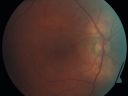
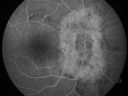
67-year-old man with a history of a peripapillary lesion in the right eye. He comes back today reporting his vision has been coming and going and it changes with his blood glucose fluctuations. He moved between 60 and 200 and has more blurriness on the right side when his blood pressure is uncontrolled. OPHTHALMIC EXAMINATION: Visual acuity with correction 20/400 OD, 20/30 OS. IOP: 15 OD. SLIT LAMP EXAMINATION: Biomicroscopy reveals inferior scleral exposure, mild conjunctival injection, otherwise quiet anterior segment, 1+ nuclear sclerotic cataract and no anterior segment neovascularization. The anterior vitreous is mildly syneretic. EXTENDED OPHTHALMOSCOPY: Extended funduscopy with Volk 90-diopter lens and fundus drawings reveals a clear view with a posterior vitreous separation. C/D ratio is 0.3. Large retinal vessels show 2+ arterial attenuation and arteriovenous crossing changes. There are 1-2+ intraretinal dot-blot hemorrhages. The retinal periphery is flat and intact with no breaks or detachments. The macula shows cystoid edema present centrally extending nasally in a yellowish lesion surrounding the optic nerve head. B-SCAN ECHOGRAPHY: The right eye shows a posterior vitreous separation and no increased reflectivity or diameter of the area around the optic nerve head in the right eye compared to the left eye. There is no consistency with any sort of elevated lesion or osteoma. IMPRESSION: 1. PERIPAPILLARY CHOROIDAL NEOVASCULAR MEMBRANE RIGHT EYE 2. CYSTOID MACULAR EDEMA RIGHT EYE 3. POSTERIOR VITREOUS SEPARATION RIGHT EYE 4. CATARACTS 5. DIABETES MELLITUS WITH NONPROLIFERATIVE DIABETIC RETINOPATHY DISCUSSION: The patient and I talked about his macular condition. I do feel this is most consistent with a peripapillary or occult choroidal neovascular membrane, although it is unusual in appearance. I feel observation would not result in spontaneous improvement and I feel it is fair to attempt anti-neovascular anti-VEGF medication. I do not think this is an osteoma, based on its ultrasonographic and clinical appearance, but I do think a systemic work-up is indicated. |
|||||||
|
|
|
|
||||
|
|
|
|
||||
|
|
|
|
||||
|
|
|
|||||
|
|||||||
67-year-old man with a history of a peripapillary lesion in the right eye. He comes back today reporting his vision has been coming and going and it changes with his blood glucose fluctuations. He moved between 60 and 200 and has more blurriness on the right side when his blood pressure is uncontrolled. OPHTHALMIC EXAMINATION: Visual acuity with correction 20/400 OD, 20/30 OS. IOP: 15 OD. SLIT LAMP EXAMINATION: Biomicroscopy reveals inferior scleral exposure, mild conjunctival injection, otherwise quiet anterior segment, 1+ nuclear sclerotic cataract and no anterior segment neovascularization. The anterior vitreous is mildly syneretic. EXTENDED OPHTHALMOSCOPY: Extended funduscopy with Volk 90-diopter lens and fundus drawings reveals a clear view with a posterior vitreous separation. C/D ratio is 0.3. Large retinal vessels show 2+ arterial attenuation and arteriovenous crossing changes. There are 1-2+ intraretinal dot-blot hemorrhages. The retinal periphery is flat and intact with no breaks or detachments. The macula shows cystoid edema present centrally extending nasally in a yellowish lesion surrounding the optic nerve head. B-SCAN ECHOGRAPHY: The right eye shows a posterior vitreous separation and no increased reflectivity or diameter of the area around the optic nerve head in the right eye compared to the left eye. There is no consistency with any sort of elevated lesion or osteoma. IMPRESSION: 1. PERIPAPILLARY CHOROIDAL NEOVASCULAR MEMBRANE RIGHT EYE 2. CYSTOID MACULAR EDEMA RIGHT EYE 3. POSTERIOR VITREOUS SEPARATION RIGHT EYE 4. CATARACTS 5. DIABETES MELLITUS WITH NONPROLIFERATIVE DIABETIC RETINOPATHY DISCUSSION: The patient and I talked about his macular condition. I do feel this is most consistent with a peripapillary or occult choroidal neovascular membrane, although it is unusual in appearance. I feel observation would not result in spontaneous improvement and I feel it is fair to attempt anti-neovascular anti-VEGF medication. I do not think this is an osteoma, based on its ultrasonographic and clinical appearance, but I do think a systemic work-up is indicated.